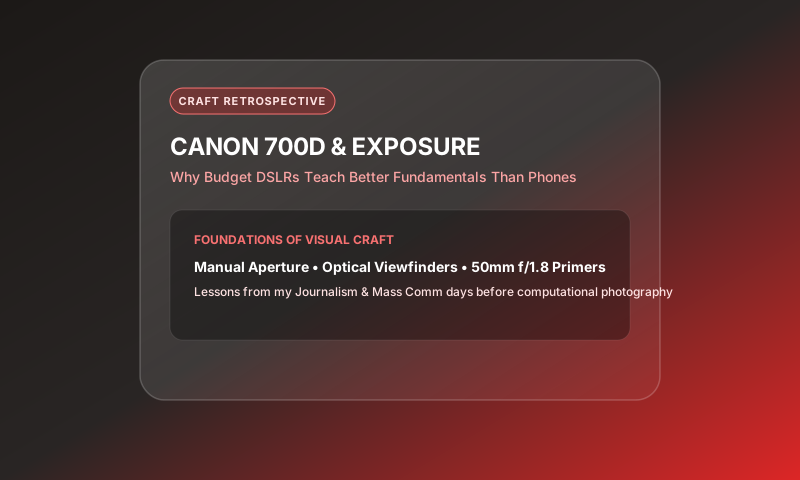
My Mass Communication Roots: The Class of Canon 700D
During my Bachelor of Arts in Journalism and Mass Communication at Chaudhary Charan Singh University, the Canon 700D (Rebel T5i) was our entry gate into the visual universe. At the time, modern mirrorless marvels and smartphone sensor-shift stabilization didn't exist in classroom budgets.
We were handed heavy camera bodies with basic optical viewfinders, manual dials, and an 18-55mm kit lens. There was no real-time histogram floating in an electronic viewfinder to tell you if your shot was exposed correctly. You had to look at a small analog needle scale inside the optical pentamirror, measure light with your eyes, and calculate exposure in your head.
It was frustrating, punishing, and easily the most valuable foundational training of my entire creative career.
The Exposure Triangle Under Hard Sensor Limitations
On modern cameras, you can crank the ISO up to 6400 or 12,800 without batting an eye. The Canon 700D's 18MP APS-C sensor, by contrast, fell apart completely if you pushed it past ISO 1600. Noise crept across shadows like television static.
Because you couldn't rely on high ISO to bail you out, you were forced to respect the other two pillars of the exposure triangle: aperture and shutter speed. More importantly, it forced you to understand lighting. If a scene was too dark, you didn't touch the ISO button—you moved the subject closer to a window, brought in a reflector, or adjusted a desk lamp to balance the contrast.
When you learn to shoot under strict technical constraints, you develop lighting instinct. You stop viewing a camera as a magic box that sees in the dark and start viewing it as a sensitive surface that requires intentional illumination.
The Legendary 50mm f/1.8: The Best $100 Education You Can Buy
The turning point for every DSLR student was replacing the plastic kit zoom with Canon's iconic 50mm f/1.8 (fondly dubbed the 'Nifty Fifty').
A prime lens has no zoom ring. If you want a tighter frame, you take three steps forward; if you want a wider frame, you take three steps back. That physical movement teaches you composition, focal plane perspective, and background compression faster than any textbook.
At f/1.8, the depth of field is razor thin. You learn manual focus control the hard way—because if you miss focus by two centimeters, the subject's ear is in focus while their eyes are completely blurry. Mastering that manual focus ring under pressure built muscle memory that serves me on commercial sets to this day.
Optical Viewfinder Discipline
Shooting through an optical viewfinder connects you to reality in a way that staring at a smartphone screen never can. You see pure light reflected through glass mirrors, with zero digital latency, zero synthetic sharpening, and zero battery-saving screen dimming.
It forces you to keep both eyes engaged: one eye pressed against the rubber eyecup composing the subject, and your left eye open watching the room to anticipate movement and framing changes. That environmental awareness is essential when filming dynamic news events, public protests, or live corporate functions.
Why Modern Creators Rely Too Much on AI Crutches
Today, smartphones and new cameras offer eye-tracking autofocus that never misses, computational HDR that prevents blown clouds, and automatic night modes that turn pitch black into daylight. While these conveniences save time, they also breed creative laziness.
If you never experience the pain of a blown highlight or a noisy shadow, you never learn why soft diffusion panels, negative fill, and deliberate color temperature matter. The Canon 700D may be an antique by 2026 standards, but the foundational principles it taught me remain the bedrock of every high-end campaign film I produce today.
“When a camera has no AI to fix your bad lighting, no computational HDR to rescue blown highlights, and noisy grain above ISO 800, you are forced to actually learn the craft of cinematography.”
Key Strategic Takeaways
- Strict sensor limitations force you to master lighting and physical composition rather than leaning on automated digital fixes.
- A fast 50mm prime lens teaches framing and depth of field better than any zoom lens.
- Optical viewfinders build situational awareness and timing when capturing unscripted live events.
- True visual craftsmanship comes from understanding light, shadow, and human connection—not from owning the most expensive camera.
Canon EF 50mm f/1.8 STM Lens
Field Verdict: The legendary 'Nifty Fifty' remains the single greatest affordable prime lens ever manufactured. Sharp, lightweight, and teaches true depth-of-field control.
- •Bright f/1.8 aperture produces beautiful background blur and excels in low light
- •Smooth, near-silent STM stepping motor suitable for both photography and video
- •Ultra-compact footprint weighs only 160 grams
- •Incredible optical sharpness in the center frame for portraits and interviews
- •Narrow field of view (80mm equivalent) on APS-C crop sensors requires stepping back indoors
- •Plastic outer barrel construction (though features a durable metal lens mount)
*Affiliate Note: When you buy through links on this site, I may earn an affiliate commission at no extra charge to you. I only write about gear I personally own and deploy on commercial client productions.

Written by Deepanshu Kainthola
Digital Marketing Manager at Vision India Services Pvt. Ltd.. Practical marketing execution backed by strategic and business thinking. 7.7 Years Exp. orchestrating digital campaigns, employer branding, SEO, content architecture, and multi-brand growth across 12+ flagship enterprise entities.