The Moment Ads Started Feeling Hollow
Open your Instagram, YouTube, or LinkedIn feed today, and you will likely spot it within three swipes: an ad featuring an oddly flawless face, skin with a subtle plastic sheen, and ad copy that begins with something like, 'In today’s fast-paced digital world...'
Your thumb does not even pause. You scroll right past it without reading a single word. There is no anger involved; it is an instinctive filter. Your brain registers that whoever ran the ad did not care enough to hire a real creator, shoot an authentic video, or share an original perspective. If the brand put zero human care into making the message, why should you invest your hard-earned money in their product?
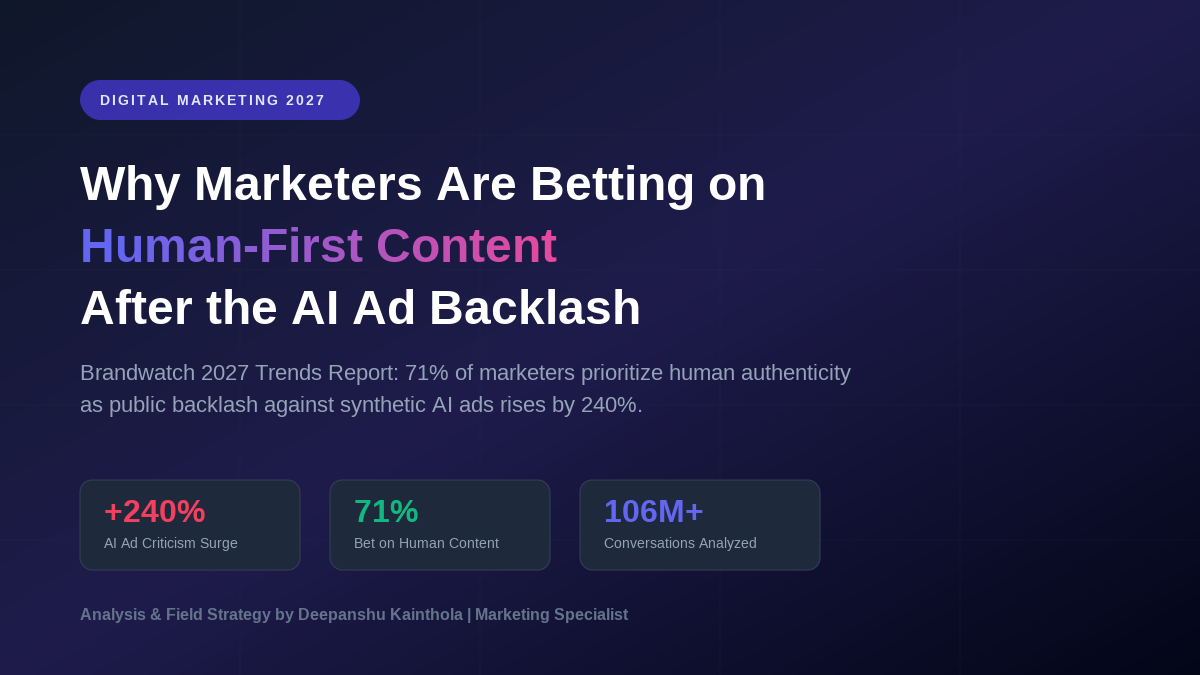
For the last two years, industry commentary promised that generative AI would completely replace human creative teams by 2027. But hard market data is now telling a completely different story. According to Brandwatch's Digital Marketing Trends 2027 report—which analyzed over 106 million public online conversations and surveyed more than 1,000 marketing leaders—consumer frustration with synthetic advertising has reached a breaking point.
Online discussions criticizing AI-generated ads surged by 240% in the past year, with public sentiment skewing heavily negative. Meanwhile, social chatter actively questioning whether a campaign was 'fake or bot-made' rose by 186%. As a direct consequence, 71% of surveyed marketers crowned 'Human-First Content' as their number-one priority for 2027, as reported by BestMediaInfo.
The gold rush of cheap automated copy is officially hitting diminishing returns. As someone who has spent the last 7.7 years planning campaigns, directing retail store launches, and producing video content across enterprise brands, this shift comes as no surprise. Technology scales distribution, but trust requires human proof.
The 'Sameness' Trap: Why Cheap Automation Kills Trust
Generative AI democratized content production, but it also democratized mediocrity. When twenty competing brands use the same large language models with the same generic prompts, their output begins to sound like one single, polite, homogenized copywriter.
Marketers call this 'creative sameness.' When every competitor publishes the same listicle formats, uses the same pastel-toned vector art, and generates synthetic video avatars with unnatural hand gestures, audiences develop sensory fatigue.
In ad campaigns, novelty wears off fast. When an audience suspects that a product review or video testimonial was synthetically generated, conversion rates fall off a cliff. Performance dashboards reflect this immediately: click-through rates (CTR) decline, cost-per-acquisition (CAC) creeps upward, and post-click bounce rates spike because the visitor felt deceived before they even arrived at your landing page.
Brand loyalty is built on vulnerability and credibility. An algorithm cannot experience frustration, negotiate on-site logistics, test a continuous studio light, or take accountability when a campaign underperforms. When you eliminate the human element from your marketing, you also eliminate the emotional anchor that makes people care about your brand.
What 'Human-First' Actually Looks Like on the Ground
'Human-first content' is not an anti-technology slogan, nor does it mean throwing out digital tools. It simply means focusing your creative effort on things an AI cannot fabricate.
Here is what this looks like based on real campaigns I manage across retail, healthcare, and corporate operations:
1. Real Faces, Real Texture, and Physical Environments: When we planned new store opening marketing campaigns and retail visuals for Meena Bazaar, shoppers were not interested in synthetic 3D renders or generic AI fashion models. They wanted to see real fabric draping, authentic zari work under accurate studio lighting, and dynamic 4K store walkthroughs shot on physical camera rigs like our iPhone 16 Blackmagic setup. The natural motion of a handheld gimbal and the imperfect reflections of ambient showroom lights are subtle signals that scream truth to a buyer.
2. Expert-Led Marketing (Trend #3 in the Brandwatch report): Brandwatch noted that 34% of marketing leaders are prioritizing internal subject-matter experts. People follow individuals, not faceless corporate handles. When an in-house engineer explains why a software architecture was built a certain way, or a doctor explains immunotherapy treatment options (as we executed at Denvax Clinics), the content builds defensible authority that no synthetic text generator can replicate.
3. Verifiable First-Party Field Data: In our CSR skilling initiatives across Jharkhand, Bihar, and Rajasthan (documented in our SECI Ranchi case study), our reporting stood out because every single metric was verified on the ground: 121 candidates trained, ~85 placed, backed by real video interviews from assembly lines. Publishing precise, uninflated human proof beats grandiose marketing claims every single time.
The 2027 Paradox: Human for Trust, AI for Discovery
While 71% of marketers are doubling down on human content, the Brandwatch report revealed a seemingly paradoxical trend: 59% of marketers are actively adapting their strategies for Generative Engine Optimization (GEO)—optimizing their brand visibility so AI systems like ChatGPT, Perplexity, and Google AI Overviews cite them.
At first glance, this sounds like a contradiction. How do you prioritize human-first storytelling while optimizing for automated AI answer engines?
The reality is that these two forces feed each other. AI search engines do not cite generic, summarized content because they can already generate summaries themselves. As highlighted in Google's Search Central guidelines on creating helpful, people-first content, search algorithms look for authentic first-hand experience (the 'Experience' in E-E-A-T).
When an AI search engine looks for an answer to a query like *'How does the Digitek DCL-150WBC handle fan noise on commercial shoots?'*, it looks for an actual human who physically powered the light on, placed a shotgun microphone next to the heatsink, and shared raw audio notes. If your blog simply restates the manufacturer's spec sheet with an AI prompt, the algorithm ignores it.
In short: Human-first content is the raw fuel that AI search engines require to recommend you. You write for the human reader's trust, and the AI algorithm cites you because of your verified originality.
How We Are Restructuring Campaigns for 2027
To stay ahead of the AI ad backlash and capitalize on these trends, here are four practical adjustments we are implementing in our campaign workflows:
1. Ban 'Raw AI' Publishing: Use AI models where they shine—clustering search queries, transcribing customer interviews, generating negative keyword lists, and organizing raw notes. But never let raw AI text hit public channels. Every paragraph must be vetted, rewritten, and grounded by a practitioner who has actually done the work.
2. Reallocate Creative Budgets to On-Ground Capture: Rather than spending budget on expensive stock subscriptions or synthetic avatar platforms, invest in lightweight, mobile capture kits. A compact mirrorless camera or smartphone rig, paired with a reliable wireless microphone, allows your team to capture authentic behind-the-scenes moments, client walk-throughs, and genuine customer feedback anywhere.
3. Build 'Unsnippable' Assets: Brandwatch's Trend #9 highlighted 'unsnippable marketing'—creating proprietary formats that an AI search bot cannot compress into a two-line bulleted answer. This includes interactive decision matrices, field-tested video comparisons, downloadable workflow templates, and live discussions.
4. Foster Owned Communities (Trend #8): As algorithmic social feeds become crowded with synthetic noise, owned direct distribution channels become invaluable. Private email newsletters, dedicated WhatsApp community groups, and specialized industry hubs allow you to maintain direct relationships with your core audience without platform interference.
The New Competitive Advantage
The surge in consumer backlash against AI ads should not frighten marketers; it should excite those who care about quality craft.
When synthetic media becomes free, instant, and unlimited, human effort becomes the ultimate signal of credibility. Taking the time to visit a physical store, interview an actual customer, record an honest video, and write from personal conviction is no longer an operational bottleneck—it is your single most defensible marketing advantage.
Heading into 2027, the brands that win will not be the ones that push out the highest volume of automated impressions. The winners will be the brands that give people a reason to stop, trust, and believe.
“When automated content becomes free and ubiquitous, genuine human effort, physical proof, and first-hand practitioner experience become a brand's rarest, most defensible asset.”
Key Strategic Takeaways
- Brandwatch's 2027 report reveals a 240% increase in social conversations criticizing AI-generated ads, signaling widespread consumer fatigue with synthetic media.
- 71% of marketing leaders have made 'Human-First Content' their top priority for 2027, focusing on original perspectives, creator-led visuals, and practitioner insights.
- Generic AI content creates a 'sameness trap' that erodes consumer trust, raises acquisition costs, and lowers ad click-through rates.
- Human authenticity and Generative Engine Optimization (GEO) work together: AI search engines actively cite original human experiments and verified field data over synthetic summaries.
- Winning in 2027 requires reallocating creative budget from synthetic tools to on-ground capture, expert-led storytelling, and proprietary owned media.

Written by Deepanshu Kainthola
Marketing Specialist at Vision India Services Pvt. Ltd.. Marketing Specialist combining 7.7 Years Exp. across retail store openings, on-ground GTM rollouts, multi-city activations, video production, and integrated marketing campaigns across 12+ corporate brands.