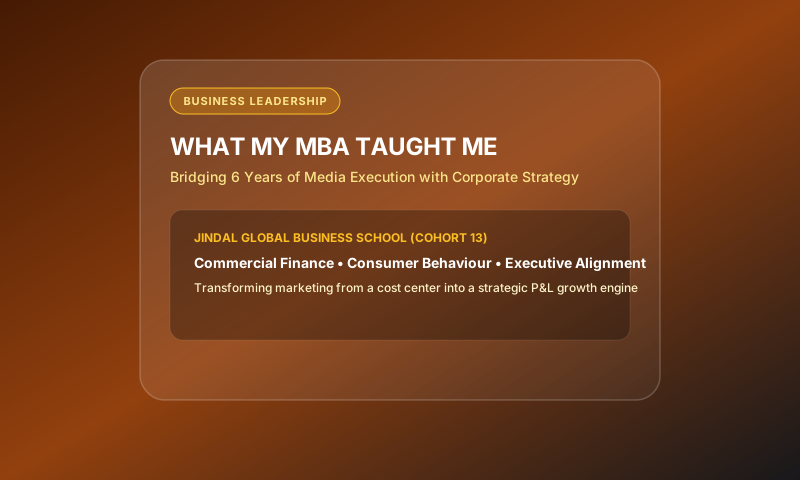
Where Media Craft Meets Commercial Rigor
My early career was rooted in the hands-on craft of visual storytelling: operating DSLR cameras, directing newsroom bulletins, lighting luxury fashion apparel, and cutting documentaries in editing suites. My Bachelor of Arts in Journalism and Mass Communication from Chaudhary Charan Singh University taught me how to tell stories that hold human attention.
Yet, as my responsibilities grew from producing single videos to managing integrated marketing across 12+ enterprise brands at Vision India Services, I realized that creative execution is only half the battle. If a marketing leader cannot read a corporate balance sheet, understand unit economics, calculate customer lifetime value (LTV:CAC), and speak the language of commercial strategy, they will always remain an operational order-taker rather than a strategic decision-maker.
Pursuing my Master of Business Administration (MBA) at Jindal Global Business School was an intentional decision to bridge the gap between creative visual intuition and enterprise business acumen.
Why Creative Leaders Need Financial Literacy
In many agencies and corporate departments, there is a painful wall between creative marketers and the finance team. Marketers present creative concepts; CFOs ask about return on invested capital (ROIC) and payback periods; neither side understands the other's language.
My MBA erased that divide. When you understand contribution margins, customer acquisition economics, and working capital constraints, your creative ideas become ten times sharper. You stop pitching vanity video ideas that look pretty in an award reel and start architecting campaigns that systematically de-risk sales cycles.
Financial discipline does not stifle creative storytelling—it focuses it on the problems that actually matter to the business.
Business School Frameworks in Daily Marketing Execution
Academic frameworks are often dismissed as theoretical, but when applied to real operational challenges, they provide invaluable clarity. Concepts like Porter's Five Forces, Blue Ocean Strategy, and Behavioral Economics illuminate why certain marketing initiatives succeed while others burn cash.
For example, applying consumer psychology and friction-reduction theory directly guided our overhaul of Just Job's recruitment funnel: recognizing that cognitive load on mobile forms caused candidate abandonment led directly to our high-converting conversational WhatsApp engine.
Similarly, competitive positioning frameworks showed us that GreenCall HRMS could never outspend venture-funded SaaS giants on brand advertising, so we engineered an asymmetric organic search strategy targeting statutory compliance queries where we could dominate uncontested.
Multi-Brand Scaling & P&L Awareness
Managing marketing across diversified business units—staffing, skilling, SaaS, and CSR—requires understanding different business models simultaneously.
A high-volume blue-collar job portal operates on micro-unit acquisition margins and instant turnaround; an enterprise B2B SaaS platform operates on long, 6-month sales cycles with high contract values; a national skilling initiative operates under public-private CSR milestones.
Because of my business school training, I treat each brand as a distinct financial engine with its own cost structure, margin requirements, and conversion milestones, rather than applying a lazy one-size-fits-all marketing playbook across everything.
The Modern Hybrid Marketing Executive
The modern marketing landscape has no room for narrow specialists who only know how to run Facebook ads or only know how to edit videos. The future belongs to hybrid leaders: individuals who can sit on a factory floor with a camera and wireless mic, walk into an editing room to color-grade a brand film, and then step into the boardroom to present a data-backed customer acquisition strategy to the CEO.
Connecting my Mass Communication roots with Jindal Global Business School strategic rigor has defined my professional identity: practical execution backed by rigorous business thinking.
“A creative producer asks: 'Does this video look stunning?' A business leader asks: 'Does this visual asset shift consumer behavior, protect our margins, and generate sustainable enterprise value?' Both questions must be answered together.”
Key Strategic Takeaways
- Creative storytelling without commercial financial acumen results in wasted marketing capital.
- Understanding unit economics, LTV:CAC, and payback periods transforms creative concepts into defensible business investments.
- Rigorous business school frameworks provide clarity when managing complex multi-brand portfolios.
- The most valuable marketing leaders are hybrids who bridge ground-level production craft with executive boardroom strategy.

Written by Deepanshu Kainthola
Digital Marketing Manager at Vision India Services Pvt. Ltd.. Practical marketing execution backed by strategic and business thinking. 7.7 Years Exp. orchestrating digital campaigns, employer branding, SEO, content architecture, and multi-brand growth across 12+ flagship enterprise entities.