1. The Trap of The 'Busy' Marketing Team
In modern corporate marketing departments, there is an unspoken anxiety: if the social feed is silent for 48 hours, or if we haven't published a blog post this week, someone upstairs might think we aren't working.
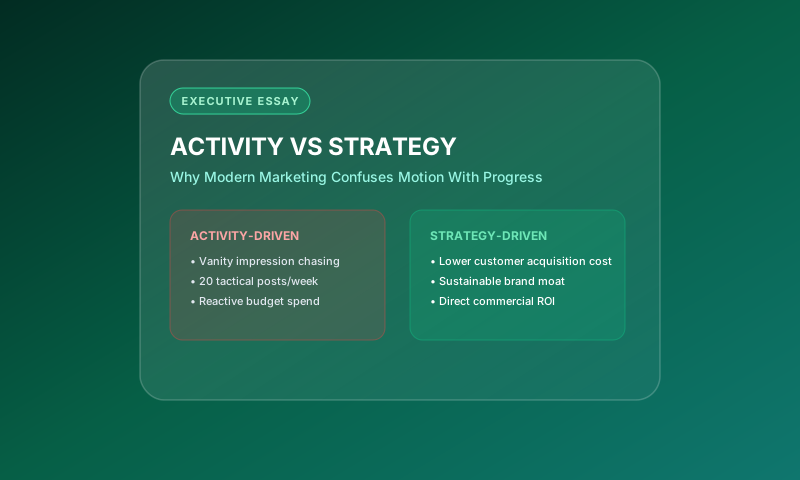
The result is a relentless treadmill of tactical output. Teams celebrate publishing 20 posts a month, launching five ad variations, and tweaking button colors on a landing page. But when the quarter ends and the board asks: 'Did this lower customer acquisition cost? Did this improve brand premium or shorten our enterprise sales cycle?', the room falls silent.
2. What Activity-Driven Marketing Looks Like
Activity-driven marketing is reactive by nature. It starts with a channel ('We need to be active on TikTok' or 'We should run Google Ads') rather than a commercial constraint ('Our enterprise deal pipeline has a 90-day consideration lag').
Teams focus obsessively on top-of-funnel impression counts rather than qualified lead velocity, constantly pivoting campaigns based on whichever competitor made a post yesterday.
3. What Strategy-Driven Marketing Actually Looks Like
When marketing teams shift from measuring 'What did we produce today?' to 'What market bottleneck are we solving for this quarter?', everything changes. Messaging sharpens, acquisition funnels simplify, and marketing stops being viewed as an unpredictable cost center and becomes an undeniable growth driver.
“Activity is easy to measure; strategy requires answering hard trade-offs. Activity produces calendar checkboxes; strategy produces competitive moats and commercial outcomes.”
Key Strategic Takeaways
- High volume of content without distribution discipline is vanity expenditure.
- Strategy is fundamentally about choosing what NOT to do.
- Every marketing initiative must tie back to one of three levers: Lower CAC, Higher LTV, or Shorter Sales Cycles.
- True marketing leadership bridges creative storytelling with business balance sheets.
Executive Marketing Glossary

Written by Deepanshu Kainthola
Digital Marketing Manager at Vision India Services Pvt. Ltd.. Practical marketing execution backed by strategic and business thinking. 7.7 Years Exp. orchestrating digital campaigns, employer branding, SEO, content architecture, and multi-brand growth across 6 flagship enterprise entities.